Showing posts with label Old Town Barcelona. Show all posts

Friday, August 7, 2009

Public Toilet Map for Barcelona City Centre

This might seem like an odd post, and it's definitely one for the tourists reading, but I think it's a pretty valuable addition to a guide book/photocopy to have in the back of your guide/map. Basically, it's a map I picked up for the local council office the other day (it's actually from 2006) and shows the location of all of the public toilets in Cuitat Vella - the 4 neighbourhoods of El Raval, the Gothic Quarter, Borne/Rivera and La Barceloneta. (Apologies for the por quality of the image but if you click, it's a bit clearer).

WC location in Cuitat Vella - Barcelona Sights

It's obviously a sore point for some bar owners in the city, who often have hand-written notes reminding people who stumble into their bar that "the toilets are for customers only" and the like. Pretty common around the old town, I think you'll agree. So the above map is actually something I'd love to be given if I was visiting a new city - OK, my kids can use a tree stump or a drain (they're both under 4) but it's not quite the same for me! So I hope this serves a purpose for someone out there, and saves you buying a coke somewhere when the last thing you want is to drink some more!

Coming to Barcelona soon? Try Apartments for rent in Barcelona as a great alternative to hotel rooms. And for a heads up on the main city sights, check out this Barcelona Guide.

Wednesday, February 11, 2009

"Roman Wall in Your Car Park, Sir?"

It's common for any kind of building work in the old town of Barcelona to begin with an approximate time scale, and then go way over on the completion time. OK, I know you're thinking that it happens with any building project, but in the old town, it takes a lot longer. Why? Well, because you have to go underground, and that's when you start to uncover the remnants of the ancestors.
Barcelona Sights - Scanning the ground
Public Parking in Barcelona is a bit of a nightmare. There are not enough street parking spaces for the number of cars in Barcelona, and despite the council introducing the "Zona Verde" or "green zone" 3 years ago, it's still a major problem. The green zone parking is an initiative where only residents of the postal code can park in their own streets - thus eliminating the workers from outside of Barcelona from taking up the parking spaces, and also encouraging the use of public transport - it's well documented that Barcelona wants to be more "green" after worrying levels of pollution were publicised. Perhaps the name for the "Green" zone was not chosen by chance...

So the reason for the title of the post is that when new buildings are constructed in the old town - like the new buildings out of town - almost all have underground parking lots. And here lies the problem.
Archeaologists in the old town - Barcelona sights
Barcelona was founded as a Roman Citadel caled Barcino. It's amazing to see such history, in the City's History Museum, for example (an upcoming post, guys, be sure to subscribe) and this is also evident in other parts of the old town. My own car park in Carrer de Les Flors, for example, has the remains of the Roman Wall within it. I remember also around 5 years ago, in the Gothic quarter, plans were made for a new underground car park, only to be scuppered, upon discovering Roman Ruins, which is now the rather unimpressive Plaça Vila de Madrid (not for me, but the residents would have much preferred another car park, rather than some roman ruins frequented by stray cats).

The above photos were taken at the site of the old public swimming pools in the Raval, which were demolished to make way for new apartment blocks for elderly residents (many of which were turfed out of their homes when the new Barceló Raval Hotel was built). As usual, the demolished site sat completely untouched, collecting rubbish for around a year before the current work started. It's also the scene of old addidas ad filmed just before the World Cup 2006 in Germany.

So now, it's a painstaking wait to see if there's anything of value/historical significance with small paintbrushes dusting over old stones. Don't misinterpret this post - I think I've got one of the coolest car parks in Barcelona - how many can say they have a roman wall as part of their car park? I just wonder why this couldn't have started immediately after demolition, lasted a year or whatever (which was as long as it sat untouched) and then started the building work?
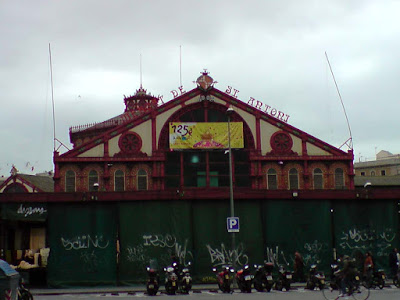
Mercado San Antonio - Barcelona Sights

It doesn't surprise me that the market traders at the nearby Sant Antoni market are bracing themselves for a very long "temporary" move. The 150-odd year old market is actually Barcelona's biggest and is also to undergo a severe makeover - also involving underground car parks. Fishmongers, butchers and grocers are to be turfed out to the neighbouring streets in the meantime (work has already begun) and are worried at hom much excavation might delay the works, leaving them in temporary conditions for perhaps 2 or 3 years!

Comments welcome guys, and for more information on Barcelona, see this great Barcelona Guide. Also, for your accomodation needs, I reccomend trying apartments for groups in Barcelona as a great alternative to hostal bunk beds.

Thursday, November 13, 2008

Portaferrissa - the Old Iron Gate of the City

Most people nowadays pass through what was once the Old Iron Gate to the Roman City of "Barcino" without even thinking about it, and straight into Carrer Portaferrissa with one thing in mind - Shopping. This is one of the best streets to start your shopping visit to Barcelona with a plethora of shops squashed into this famous street of the Gothic Quarter.
Barcelona sights - Portaferrissa Fountain
Portaferrissa roughly translates to Puerta fierro/hierro which means "Iron door". At the entrance to the street there is a fountain, one would imagine from Roman times for the horses with carts to drink on their arrival. The fountain or trough has been decorated with coloured tiles, explaining the history of the fountain. I myself have passed by many times, but had never stopped to read the text. I have taken photos and joined the image below, which you can view for yourselves.

"The "Porta Ferriça" was one of the entrances to the second wall of Barcelona, built in the 13th Century. The Iron bar - one of the longitudinal measurements used in the city - gave it's name to (the gate) as well as the street that lead to the gate from the centre of the old town. In Calle Portaferrissa at the beginning of the 16th Century, the Casa Gralla was built; a beautiful Plateresque building which disappeared with the opening of Calle del Duque de la Victoria (Duke of the Vicotry) and the Casa Pinos (Pine House) belonging to the Marquis of Barbera was demolished in the middle of the 19th Century. The construction of the "Moya" Palace (today "Comillas") in 1774, finally proved motive to demolish the old gate."

Barcelona Sights - Portaferrissa fountain detail

For more information on Barcelona, see this Barcelona Guide.

Cheap Barcelona Apartments

Sunday, November 2, 2008

The Old Town Districts

So you thought the Barcelona Old Town had 4, maybe 5 districts, right? Raval, Gotico, Borne, Ribera and Barceloneta (or maybe include San Pere). Well that's what I thought too, until I saw this signpost recently in a street in the Raval.
Barcelona Old Town
I love the old image of the man leading the horse to show the direction of the street. No arrows here my friend.
It's located very close to Calle Carretas - a name which also suggests that the once cobbled streets would have been used by horse and carts delivering and collecting merchandise from the local factories (Raval has loads) and other bars, restaurants, etc.

So according to the plaque, the old town, or maybe it refers to the city as a whole at that time, has at least 8 neighbourhoods in at least 4 districts. I've seen old maps and city plans of Barcelona at various times, but I love the fact that these old plaques still exist, as it gives it all much more character. OK, so many of the buildings need a facelift (!), but I like the old and new together. Feel free to comment on places that have caught your attention, or if you can expand on the old districts and barrios and manzanas, etc. then I'd also love to hear!

For more information on Barcelona, see this Barcelona Guide.

Cheap Barcelona Apartments
 
Follow Me on Twitter