Showing posts with label Barcelona History. Show all posts

Saturday, January 8, 2011

Hidden Barcelona Tunnels - Refugio 307

Now Barcelona has had a turbulent history. From Roman times, Spanish Armadas, civil wars and the like it's no surprise that there are many stories hidden beneath the city streets of today. A wander in the Gothic Quarter of Barcelona's Old Town will take you to the City History Museum, where you can literally be transported thousands of years to the past with a Roman village beneath the streets.

Refugio 307 - Barcelona sights Blog

Montjuic Mountain also has many stories hidden in its rock. During the civil war the castle was used as a prison, and locals will tell you how many people were imprisoned simply for speaking the Catalan language. The elder generation have more vivid memories of these times and for many, a simple thing like taking the subway can bring back terrible memories. Underground tunnels with the alien sounds of oncoming trains and clackety-clack of rail-lines are too close to the fear that these children felt so many years ago when they huddled in underground tunnels and sewers, taking shelter from the danger overhead. There were many such shelters built during the civil war, some say as many as one thousand, but one has remained in excellent condition. Welcome to Refugio 307.

Cut deep into the city's bowels in between the old town and Montjüic, in the neighbohood known as Poble Sec lies a myriad of tunnels over 200 metres which included children's area, a medical station and many individual rooms. The indiscriminate bombings the city suffered at the time are brought sharply back to focus with this excellent example of the fight for survival that the local people must have had to confront at the time.

Refugio 307 can be visited for a guided tour (only Spanish and Catalan) daily at the cost of 3 Euros and is located very centrally on Carrer Nou de la Rambla, 169. Metro stop Parallel (exit funicular exit).


This is a guest post from Paul Jones who writes about Barcelona Raval apartments and Budget Barcelona apartments.

Thursday, February 25, 2010

History of Barcelona - A Click Away

Barcelona has had a turbulent and interesting history. A quick visit to the city History Museum gives a hint of the rich history and culture left behind by the Romans when they began building "Barcino". However, a quick visit to the History Museum is not quite enough to soak up the huge amount of information at your disposal. Not to worry, help is at hand.

Old Map of Barcelona - Barcelona Sights Blog

Barcelona council has recently launched a digital project via their website, called Barcino to BCN. This is a 45 chapter, weekly offering of history from the best sources possible, including University professors and historians. So far, the chapters (first 2) have been very digestible, and nothing like a trip back to school and a History lesson about arable farming and the like (yes, I'm English). The best thing, and the reason for including it today on the blog, is that it's all in English as well.

Barcino to BCN - Barcelona Sights Blog

The web also has some great videos (mainly in Catalan), images and plenty of other documents for you to fill yourself with little nuggets of information. Take a look at this video, for example, which shows the evolution of the actual landscape of the city which we all take for granted. Fascinating stuff. As far as I can see, the site isn't giving any kind of RSS feed, or opt-in email, so it means you'll just have to bookmark the site, and check back periodically for the next instalments.

Fancy experiencing the history of Barcelona? Check out these Barcelona apartments as a great way to stay in the old town.

Monday, February 2, 2009

Barcelona Giants

Don't be fooled by the title of the post, this has nothing to do with sports or a new football team that you haven't heard about. It's about history.

Loads of you will have passed by Barcelona council's Institue of Culture building on Las Ramblas, and probably not even realised. It's located on Las Ramblas, number 99, and is set slightly back from its neighbouring buildings. They always have a gallery exposition announced on the balconies. Know which one I mean? Well, the building is an old Palace, Palau de la Virreina, and although it's not very well publicised you can enter for free into the courtyard and see some of the most famous characters Barcelona has....els gegants.
Barcelona Sights - Gegants
The Barcelona giants are ceremonial mannequins used in the corpus Christi parade, amongst others. According to the history displays, which are completely free to visit, but not well publicised, the giants were commissioned in 1859 by the “Societat del Born” to take part in the Carnival celebrations, held each year in February and of which the nearby seaside town of Sitges has become renowned.
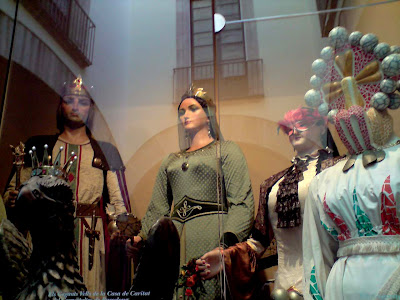
Barcelona Giants on Barcelona Sights blog
The Giants comprise of a male and female figure, rather like a King and Queen, a little girl, an eagle, two masked younger figures and a headless tribute to Gaudi – the famous Catalan artist responsible for 7 of Barcelona’s 9 UNESCO World Heritage sites.

Quoting directly from the information within the Institute of Culture, “In 1891 the giants were transferred to the Casa de Caritat, a dependency of the Deputation of Barcelona. They were used for the entertainment of orphans, formed a special feature in the Corpus Christi processions of this charitable institution and also took part in many festivals. They were restored in 1986 by Domenec Umbert. The Old Carnival Giants of the Casa de Caritat face the 21st century as the most symbolic figures in the celebrations of Carnival and Corpus Christi in Barcelona.” The giants are also paraded with pride during the week of the 24th September, when the “La Merce” festivals commence – the patron saint of Barcelona is Our Lady of Mercy.

Perhaps a puzzling figure within the giants is the crowned golden Eagle. Again, quoting from the official information, “The Barcelona Eagle is mentioned in documents as far back as 1399. As it was part of the municipal cortège, it was subject to strict protocol and was indispensable at all solemn city celebrations and on the aldermen’s journeys.

The Eagle lived its golden age in the 17th century when it was the subject of a number of dances and tunes. It disappeared in the first third of the last century and was recovered in 1989. The Eagle is part of the historic bestiary of Barcelona, together with the Lion, the Big Mule, the Bull, the Viper, the Dragon, the Monster and the little horses”.

Also of note is the “little giant – or gegantona” – who represents the figure of a girl from the 4th Century, when Saint Eulalia, one of Barcelona’s co-patron saints after the aforementioned Our Lady of Mercy, is said to have lived. Santa Eulalia was a young girl who suffered torture and ultimately crucifixion from the then Governor of Barcelona, Dacian, for her criticism of his treatment against the Christians. The figure of “Laia”, as she was more affectionately known, “represents the brave, caring spirit of the citizens of Barcelona. The giantess first appeared in 1998 for the celebration of Santa Eulalia’s day and is the newest member of the great family of figures which appear in the Barcelona festivals”.
Sant Antoni Gegants - Barcelona Sights blog
It appears that the tradition caught on, and there are other neighbourhoods in the city who have their own giants, which are used in each neighbourhood party/festival. For example, my son's school in the neighbourhood of Sant Antoni, has 2 giants and 2 "little giants" in the entrance to the school that were used at the end of January.
Barcelona Sights - giants at Sant Antoni

Coming to Barcelona soon? Try a self-catering apartment in Barcelona as a great alrternative to a hotel room. Or if you're in a group, look at apartments for groups in Barcelona.

Like what you're reading? Please leave me a comment if you're interested, or would like me to blog about anything in particular.

Wednesday, August 13, 2008

Barcelona, or Barcino?

As you may imagine from a stroll around the Gothic Quarter of Barcelona, the city is fairly old. I'm not going to go into great detail here about history and the likes, but just some random comments.

Anyone who arrives by aeroplane to Barcelona will notice a few things from the air and the windows. One may be Gaudi's "Sagrada Familia", and the other is Sitges beach as the plane swings round to land on one of the runways at El Prat airport, but another is the well observed (better by night) fact that Barcelons is on a slope.

With Tibidabo at the back, and the Mediterranean sea at the bottom, Barcelona doesn't really grow (either side is the Besos river and the Llobregat river), so Barcelona is quite hilly. Indeed, Montjüic and Tibidabo - two of the main borders of Barcelona - are considered "mountains" when really we could regard them as hills!


Barcelona was founded by the Romans on "Mons Taber" - the name they gave to the old mountain, and a name which still rings true at a pre-school in the Raval area, too, perhaps clinging to the old customs of the local "Portal de Santa Madrona" - the old gateway into Barcelona with the city walls of Paralello still visible now.

The Roman's original name for Barcelona was "Barcino" and this is what many visitors today will see (or maybe not) along side the city's Gothic cathedral - you would be forgiven for missing it, as it is staggered to be visible from a distance, say if you arrie via Portal del Angel!

On a personal note, I had visited the cathedral several times and not realised why Barcino was emblazened across the right hand side of the walls, so was happy for the history lesson (by chance through the old etchings and prints at La Pedrera)!


Barcelona apartments for groups and Cheap barcelona apartments.
 
Follow Me on Twitter